


Unlocking Quantum Advantage Through Materials
The appeal of quantum technologies lies in the promise of commercial ‘quantum advantage’. This advantage can be the computation of classically intractable problems in quantum computing, unlocking magnitudes higher sensitivity with quantum sensors, or creating fundamentally secure cryptographic solutions in quantum communications. Quantum technology has emerged in the last decade from largely theoretical to a vast range of products, business models, and a global distribution of players ranging from university spinouts to governments and international corporations.
In each case, the ability of quantum technologies to exceed the capabilities of their classical incumbents is reliant on advanced materials and fabrication processes:
- For quantum computing, the microfabrication of 1000s of identical ‘qubits’ per chip is essential to unlocking scalable computing systems that can reach the capacity to tackle commercially relevant problems.
- For quantum sensing, using materials that allow for reductions in size, weight, power, and cost (SWaP-C) per device is crucial to improving the commercial viability of products, allowing quantum sensors to enter new high-volume markets such as future mobility, healthcare, and aerospace.
- For quantum communications, materials that allow for the low-loss transmission of quantum information over long distances are vital for enterprise-scale quantum networks and cryptography solutions.

Source: IDTechEx Research.
Three Quantum Markets, Three Key Material Platforms
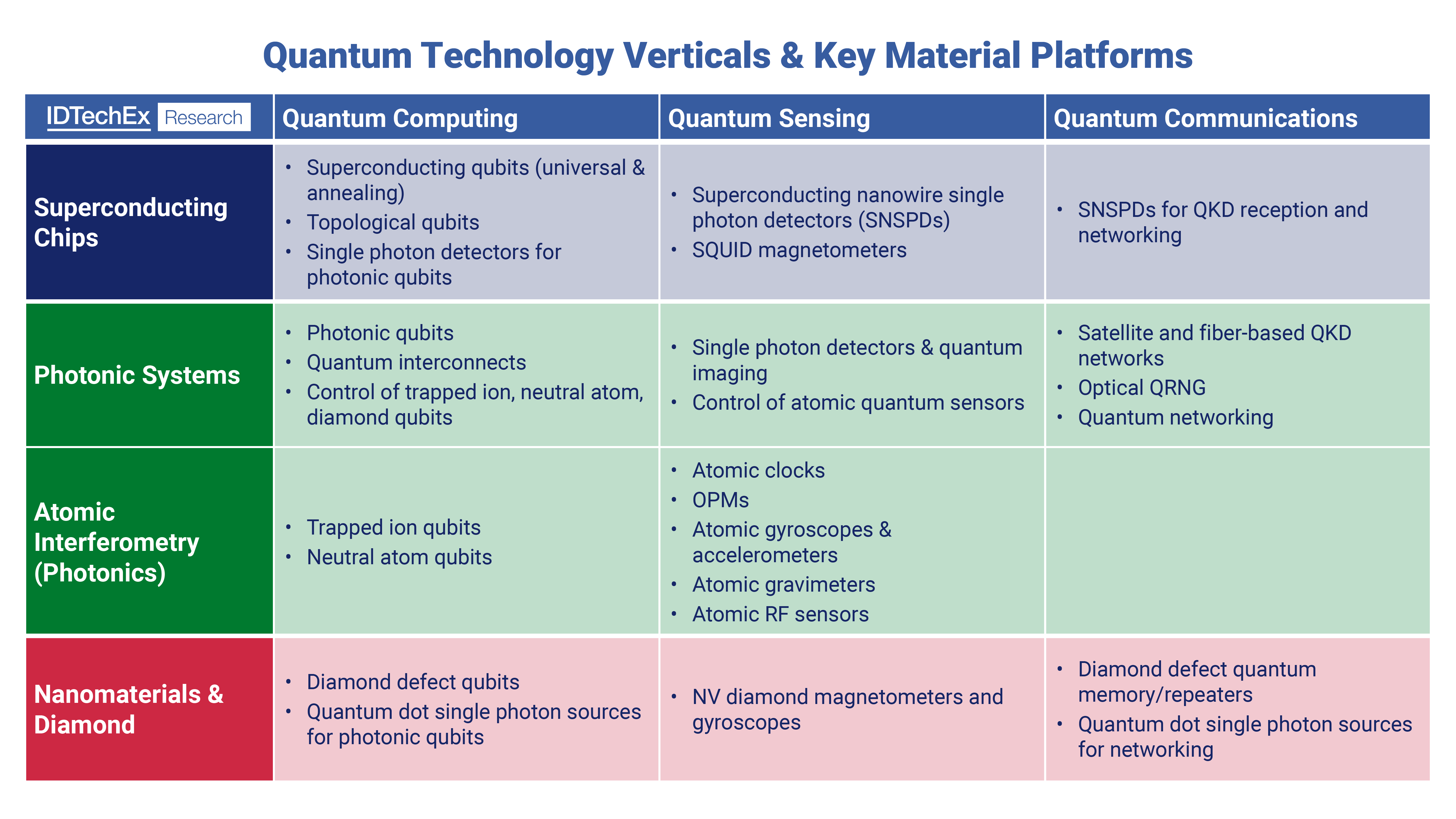
In commercial and government strategies, and in IDTechEx’s portfolio of reports on quantum technologies, the market is usually categorized by the three core product verticals: quantum computing, quantum sensing, and quantum communications. For a materials provider, it may instead be more informative to categorize quantum technologies by the physical ‘platform’ or quantum system they are built on.
The three most important materials platforms for quantum technologies highlighted in the Materials for Quantum Technologies report are superconducting chips, photonic systems (including PICs), and nanomaterials (including a range of nanocarbons and artificial diamond).
Superconducting chips are microfabricated electrical circuits made of superconducting metals or compounds which are deposited on semiconductor wafers. When cooled to cryogenic temperatures, these circuits exhibit macroscopic quantum properties with very little noise due to the low-temperature environment. Examples of commercialized quantum products built on superconducting chips are SQUIDs, SNSPDs, and superconducting qubit quantum computers.
Meanwhile, photonic systems encompass a wide range of optics and photonic components for quantum technologies. One of the most exciting approaches in this field is the use of photonic integrated circuits (PICs), which can be used either for the manipulation of single photons as carriers of quantum information, or to miniaturize the optics needed to address atomic and spin systems. Photonics are central to quantum networking and photonic qubit quantum computing but are also gaining traction for trapped ion and neutral atom qubits as well as various types of quantum sensors.
Finally, nanomaterials and diamond cover a range of materials such as CNTs, quantum dots, and 2D/2.5D materials. Artificial diamond with implanted point defects has recently gained traction as a material platform for developing both commercial quantum sensors and computers, showing potential as a robust and scalable material platform for quantum systems that can be operated at room temperature.

Image source: IDTechEx
Market Outlook
In each case, the different material platforms discussed stretch across the 3 quantum technology market verticals (computing, sensing, and communications), such that technologies and products between different market verticals can often benefit from the same material innovations and new foundry capabilities.
This report is supported by IDTechEx’s extensive market research across the quantum technology market verticals, photonics, and advanced materials. The full report expands on the opportunities highlighted in this article for a detailed examination of the technical innovations, key players, market forces, and supply chain dynamics across superconductors, photonics, and nanomaterials for the quantum industry.
link