



① According to statistics from the Cailian Press Xingkuang Data, from early 2025 to February 5, 2026, the quantum technology sector received financing totaling 2.516 billion yuan across 25 financing events; ② From the perspective of investment and financing projects in 2026, the quantum technology field demonstrates the characteristics of ‘gradually increasing numbers and growing scale’; in February, three companies received financing three times, while in January, six companies received financing seven times.
The Paper – STAR Market Daily, February 22nd report (by reporter Huang Xiumei) On New Year’s Eve, the Hefei sub-venue performance titled ‘Harmony in Fullness over the Huai River’ immediately went viral online. Renowned Chinese quantum scientist Academician Pan Jianwei and his team, along with a model of the world’s first quantum science experimental satellite, ‘Micius,’ made an appearance at the Hefei sub-venue.

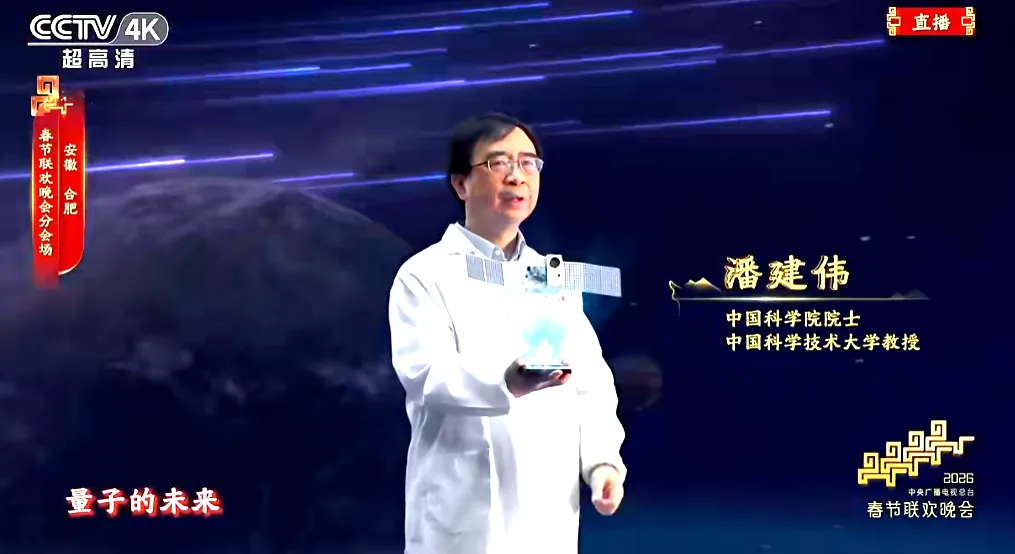
(Source: Official WeChat account of Anhui News Broadcast)


On February 12th, the journal Nature published a significant achievement by Professor Wang Jianwei and Academician Gong Qihuang’s team from Peking University: after more than six years of technical research, they developed two core chips and successfully constructed the world’s first large-scale quantum key distribution network based on integrated photonic quantum chips, named the ‘Weiming Quantum Network’.
Previously, on January 28th, the research team from the Institute of Physics at the Chinese Academy of Sciences published a paper in Nature showcasing their breakthrough in controlling the thermalization process of quantum systems during superconducting quantum chip experiments. This study innovatively adopted random multipolar driving techniques, achieving significant progress in the regulation of quantum system thermalization and laying the groundwork for the future practical application of quantum computers.
In fact, as the focus shifts from research to industry, the development of China’s quantum technology sector has seen continuous theoretical breakthroughs, with investments rapidly transforming into projects. Behind this lies the market belief that quantum computing technology is entering a critical window period transitioning from laboratory research to industrial applications.
Orient Jiafu, Legend Capital, and CAS Star are among the institutions ‘betting’ on quantum technology.
‘Promoting quantum technology, biomanufacturing, hydrogen energy and nuclear fusion, brain-computer interfaces, embodied intelligence, and sixth-generation mobile communications to become new economic growth points.’
In the ‘Suggestions of the Central Committee of the Communist Party of China on Formulating the Fifteenth Five-Year Plan for National Economic and Social Development,’ quantum technology has officially been listed as the top priority in future industrial layouts. This signifies that quantum technology has transitioned from the frontier exploration phase to become a strategic high ground that must be secured at the national level.
The strategic importance of the quantum technology track can also be glimpsed from the investment and financing activities in this field. Statistics from Cailian She Venture Capital show that, from early 2025 to February 5, 2026, over a period of more than one year, the quantum technology sector (including quantum computing and quantum computers) has raised a total financing amount of 2.516 billion yuan across 25 financing events.
Investment and financing activity in this area has been continuously rising, with an increasing number of projects and growing deal sizes breaking new records.
Specifically at the capital level, equity financing in the quantum technology track has seen frequent activity. State-owned capital, industrial capital, and venture capital institutions are focusing on core tracks and high-quality targets, forming a coordinated investment landscape. Among them, Orient Jiafu, West Lake Investment, Legend Capital, CAS Star, and Nanshan Strategic Emerging Industries Investment have become the most focused investors in this track.

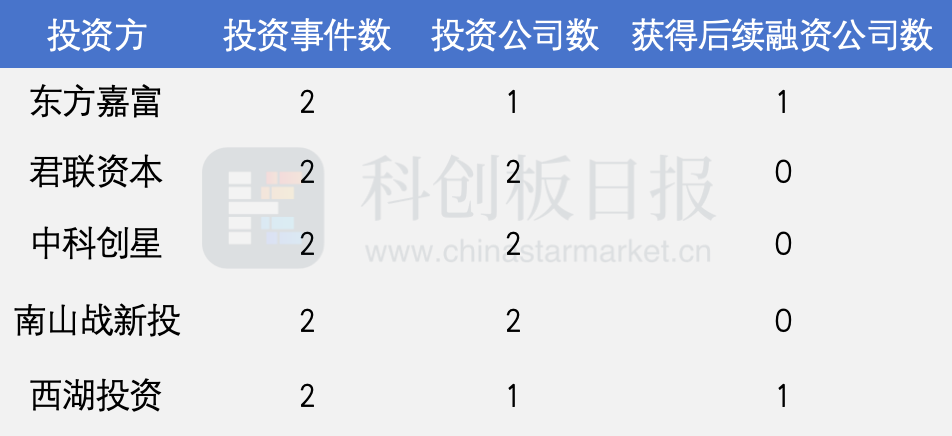
As early as 2016, Orient Jiafu invested 109 million yuan in Guo Dun Quantum. After Guo Dun Quantum was listed on the STAR Market in July 2020, it became the first listed company in China’s quantum technology field, known as the ‘first stock in the quantum technology sector.’
In April 2025, Orient Jiafu led a multi-million-yuan angel round of financing for LogicQ; other participants included Zhejiang Science and Technology Innovation Fund (Phase I), Huaxia Hengtian, West Lake Sci-Tech Investment, and Oufang Angel, among other institutions and individuals.
It is reported that LogicQ is a superconducting quantum team from Hangzhou. The team has repeatedly set world records in the field of superconducting quantum systems and holds core patents for quantum chips. Its latest chip, with a scale of 100+ qubits, has reached a world-class level.
Legend Capital, which also favors the quantum technology track, has placed its bet on Hua Yi Quantum. In July 2025, Hua Yi Quantum announced the completion of its Series A round of financing, jointly invested by Jing Guorui Fund and Legend Capital.
Hua Yi Quantum, founded in January 2022, is a developer focused on the trapped-ion quantum computing technology route. The company is committed to developing a quantum computing cloud platform, providing products such as quantum computers, quantum components, and quantum communication equipment, offering comprehensive quantum computing solutions to industry users.
CAS Star, the proponent of the hard-tech concept, showed confidence in Bu Chou Quantum. In December 2025, Bu Chou Quantum announced the completion of an angel round of financing worth tens of millions of yuan, led by CAS Star, with participation from Fosun Investment and Eastern Fortune.
The Bu Chou Quantum team mainly originates from the Neutral Atom Quantum Computing Lab at Fudan University. The founding team has deep expertise in atomic quantum computing, with systematic experimental technical accumulation and continuous technological iteration capabilities. They possess original competitive advantages in both domestic and international quantum computing sectors.
As an investment institution focusing on hard technology, Zhongke Chuangxing participated in the angel round financing of Origin Quantum, a leading domestic quantum computing company, as early as 2019.
The reason why Zhongke Chuangxing is so optimistic about the quantum technology sector is that its founding partner, Mi Lei, who proposed the concept of ‘hard technology,’ publicly stated, ‘Quantum computing will be the next-generation computing power, and we need to plan ahead.’
Since 2026, several financing projects have exceeded RMB 100 million in scale.
Looking at specific projects in the subfields of various investment and financing events, the current investment and financing in the quantum technology sector mainly focuses on accelerating the development of specialized quantum computers and deepening integration with AI and supercomputing.
Among these, quantum-classical hybrid computing infrastructure has become a key investment focus. The potential of quantum algorithms in molecular simulation and drug design is prominent, with the possibility of significantly shortening R&D cycles. Policy and capital are jointly driving technological iteration, accelerating the development of specialized quantum computers.
Specifically, from the scale of investment and financing projects since 2026, the investment and financing projects in the quantum technology sector have shown characteristics of ‘increasing numbers and gradually growing scale.’ As of now, in February, three companies have received financing three times, while in January, six companies received a total of seven rounds of financing.

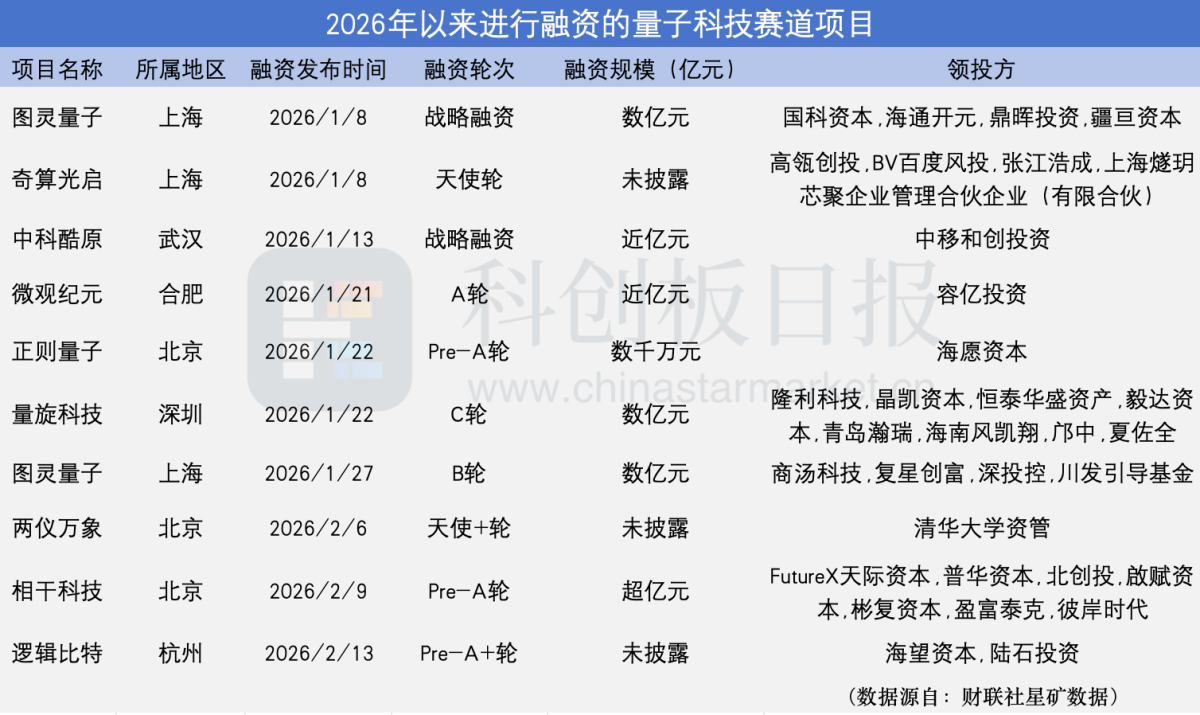
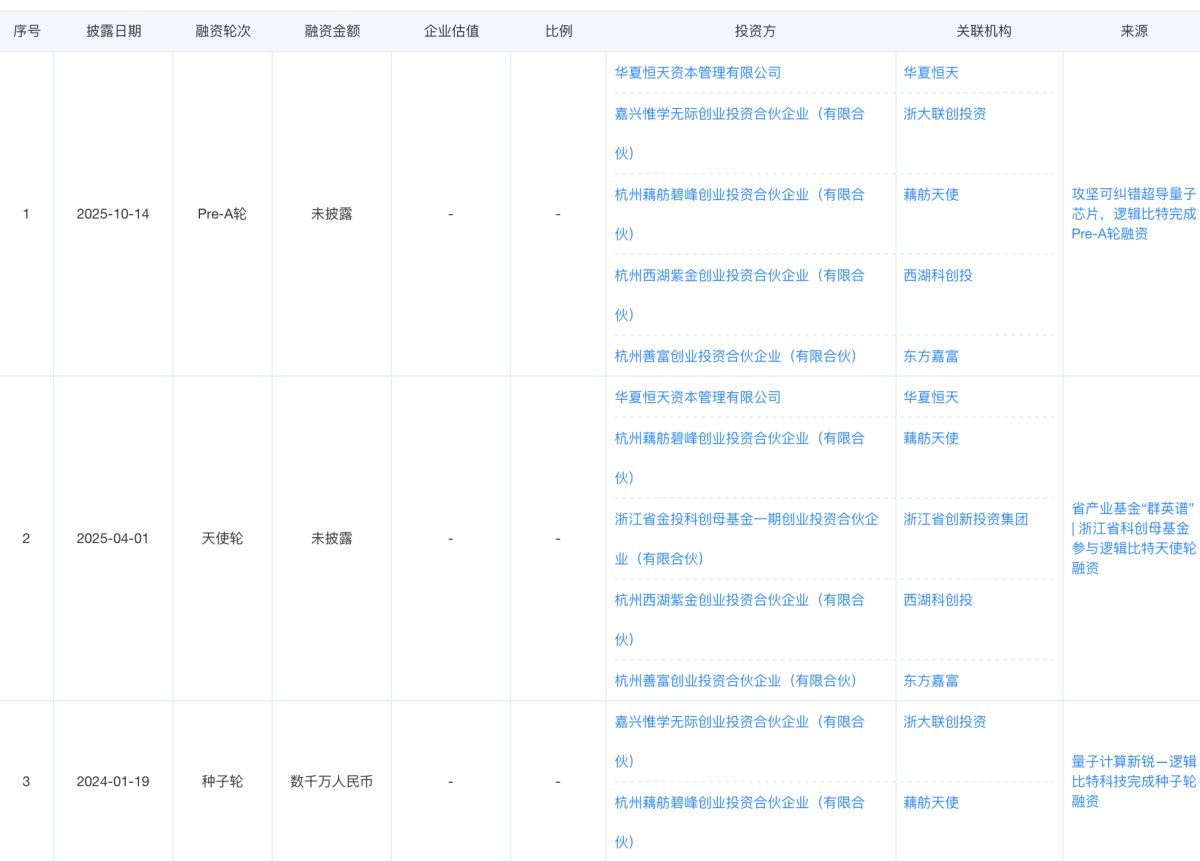
On February 13 this year, the aforementioned article mentioned that Logical Qubit announced the completion of its Pre-A+ round of financing, led by Haiwang Capital and Lushi Investment.
According to the official WeChat public account of Logical Qubit Technology, the company was established in Hangzhou in June 2022, with the vision of achieving ultra-low error rate ‘logical qubits’ and committing to the development of scalable superconducting quantum computing systems. The core team members come from Zhejiang University’s superconducting quantum computing team, which began in 2010 and subsequently achieved control over 10-qubit and 20-qubit systems, twice setting world records for global entangled qubits in superconducting quantum systems.
In 2021, Logical Qubit released the 30-qubit ‘Mogan 1’ and ‘Tianmu 1’ three-dimensional packaged quantum chips; in 2022, it further achieved the ‘Tianmu 2’ quantum chip with more than 100 qubits, with an average coherence time exceeding 100 microseconds, forming a profound technical reserve covering the entire process of superconducting quantum chip design, micro-nano processing, RF control, quantum computing, and simulation.
To date, Logical Qubit has completed a total of four rounds of financing. In January 2024, it completed a seed round of financing worth tens of millions of yuan, with investments from Zhejiang University United Innovation Investment, Zhejiang University Alumni Fund Oufang Angel, and individual investors.

In terms of financing scale, Turing Quantum completed two rounds of financing worth hundreds of millions of yuan in January this year, with only about 10 days between them. On January 8, Turing Quantum announced the completion of a nearly hundred-million-yuan angel round of financing led by Legend Star, with participation from Zhongke Shenguang, Qianhai Fund, Yuanlai Capital, and Xiaomiao Langcheng. On January 27 of the same month, Turing Quantum announced the completion of a multi-hundred-million-yuan Series B round of financing led by SenseTime, Fosun Fortune, Shenzhen Investment Holdings, and Sichuan Development Guidance Fund.
To date, Turing Quantum has completed seven rounds of financing. Its earliest angel round of financing, worth nearly a hundred million yuan, was completed in May 2021. Each subsequent round of financing has featured a relatively strong lineup of investors.

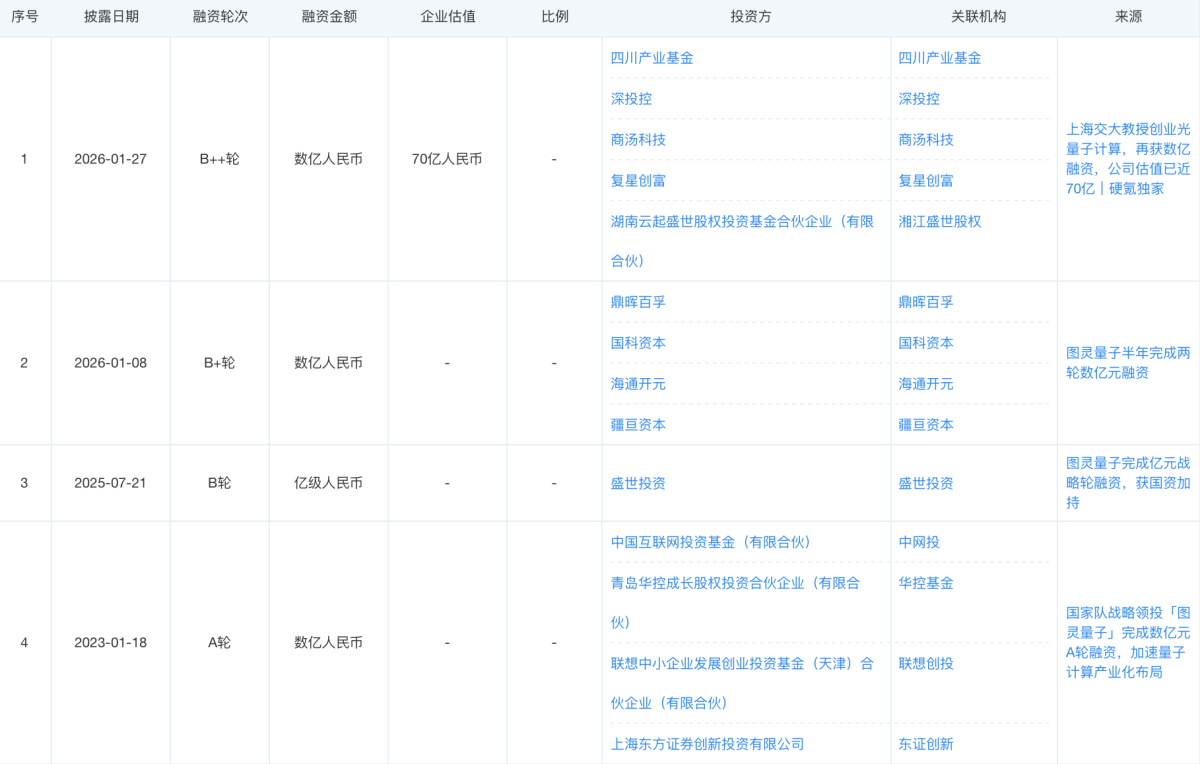
(Image: Turing Quantum’s recent four rounds of financing)
Another company that raised hundreds of millions of yuan in financing is SpinQ Technology. On January 22, the company announced the completion of a multi-hundred-million-yuan Series C round of financing from investors including Longli Technology, Yidah Capital, Jingkai Capital, and Hengtai Huasheng. This came less than six months after the disclosure of its previous Series B+ round of financing worth hundreds of millions of yuan.

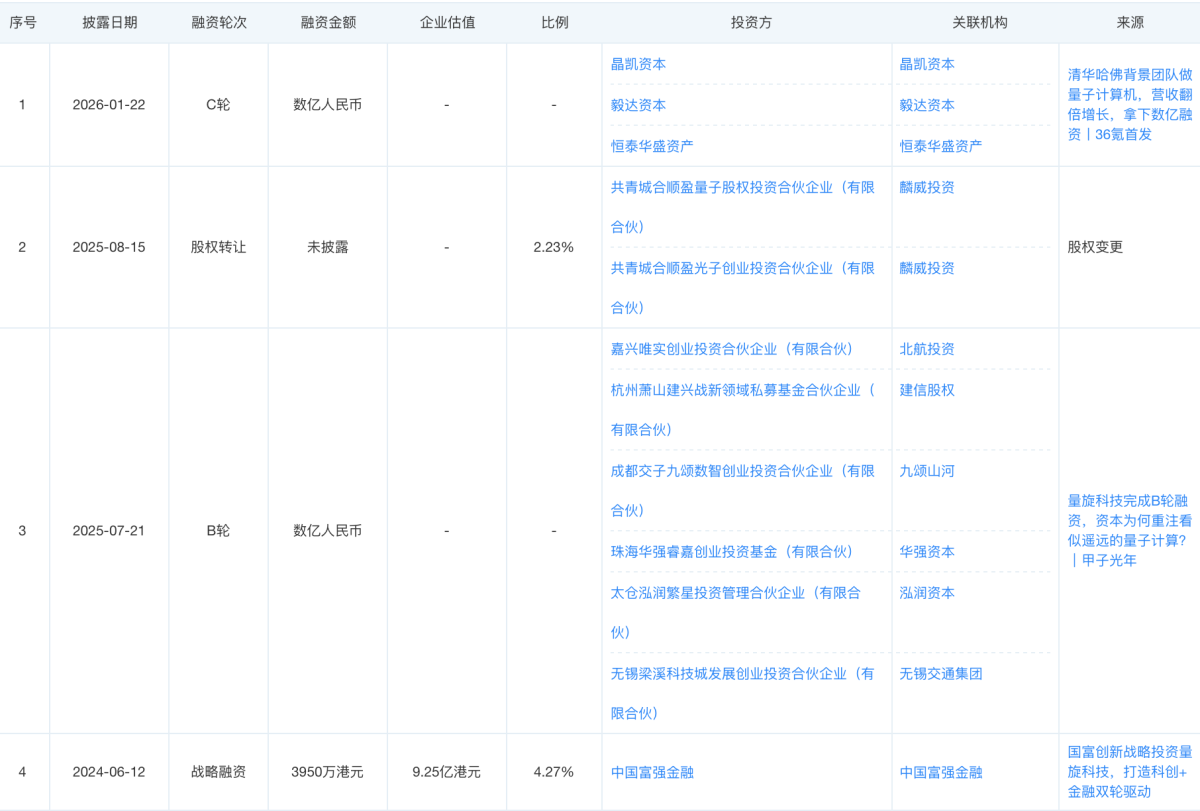
(Image: Recent 4 rounds of financing for Liangxuan Technology)
SpinQ Technology, founded in 2018, was one of the earlier companies in China to focus on superconducting quantum computers. To date, SpinQ Technology has achieved several ‘firsts’: launching the world’s first programmable desktop quantum computer; becoming the first Chinese company to export superconducting quantum chips overseas; and successfully delivering the first superconducting quantum computer exported from China.
Another company that raised over a hundred million yuan in financing is Cohere Quantum Technologies. On February 9, Cohere Quantum Technologies announced the completion of a pre-Series A round of financing worth over a hundred million yuan, led by Skyline Capital and Puhua Capital, with participation from Beijing Venture Capital, Beyond Era, Yingfu Taik, Qifu Capital, and Binfu Capital. Index Capital served as the financial advisor.
Cohere Quantum Technologies, founded in 2023, specializes in providing superconducting quantum computing technology solutions and quantum computing services. Dr. Jin Yirong, the founder of Cohere Quantum Technologies, is one of China’s pioneering figures in superconducting quantum computing. He currently serves as a researcher at the Beijing Academy of Quantum Information Sciences and leads the team responsible for building the quantum cloud platform ecosystem. He also participated in establishing the academy and led the creation of the superconducting quantum computing team and laboratory.

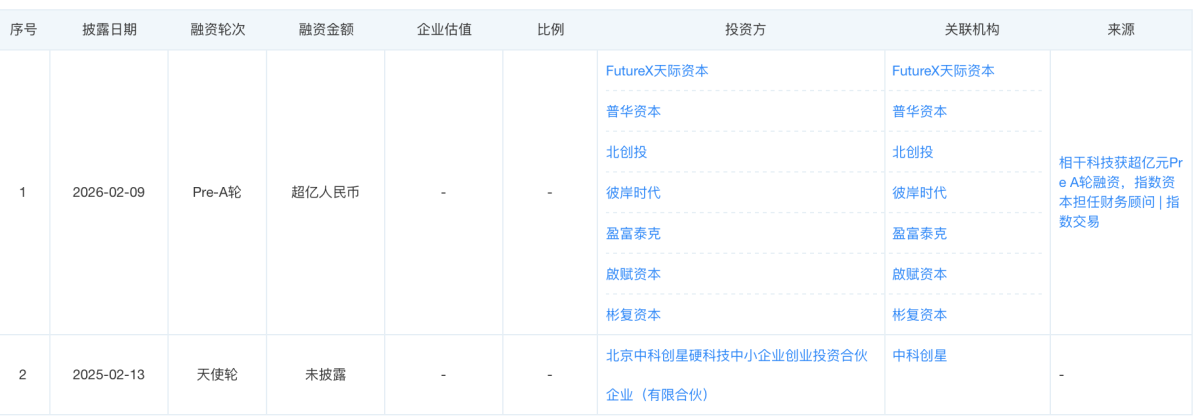
(Image: The past financing history of Xianggan Technology)
link