


Unmanned systems have already fundamentally changed warfare in the air and at sea, and now it’s the turn of ground robots, which significantly increase the chances of an infantryman’s survival and increase the effectiveness of combat operations. We tell you what tasks UAVs perform, what their advantage is for the army, and what the military and developers think about the prospects of the technology.
Kyrylo Veres, commander of the 20th separate regiment of unmanned systems “K-2”
My guys (NRC operators) did the impossible — they drove 8 km and delivered a weight of 200 kg. It was a turning point. In 2025, after taking out the first wounded person, I realized that f*ck it is possible and it must be done.

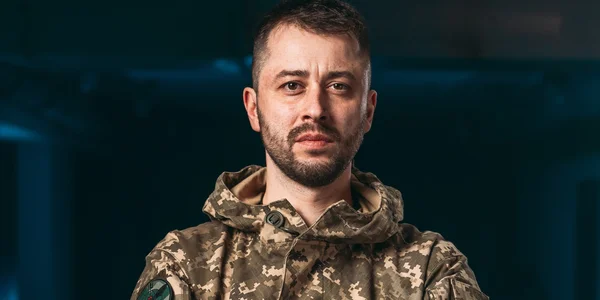
The head of the 20th Separate Regiment of Unmanned Systems “K2” Kirill Veres has radically changed his opinion about the use of ground robotic complexes on the front line. Despite the fact that he was skeptical about the introduction of NRCs, now Kirill Kirillovich is one of the key promoters of the use of ground robots in the army. This change in attitude did not happen overnight, according to Veres, before NRCs were not effective, but now they really save the lives of his charges.
“You can fight for a long time, you can fight in different ways, but life, unfortunately, is very fragile and incredibly valuable. And in order not to pay a high price for the war against the enemy, we try to use drones. It’s cheaper than fighting with people,” a technical intelligence serviceman of the 301st separate regiment of the 3rd army corps with the call sign Shum told dev.ua.
The main purpose of using ground robots is precisely to save human life. Now everyone knows the term “kill zone” – this is a section of the LBZ for several kilometers, which is under constant control with subsequent fire damage. If at the beginning of the full-scale invasion the Russians used the tactics of a fire shaft (several hours of artillery shelling), which complicated logistical tasks, then with the introduction of technology this function is performed by fpv drones, which can lie in wait in sleep mode and are activated when movement is noticed nearby. Delivery of supplies, rotation, evacuation at the front has become very difficult and dangerous.
Here, robotic ground complexes enter the scene, taking on the functions of: logistics, demining/mining dangerous areas, combat use, including kamikaze IEDs, which, loaded with explosives, break through to enemy positions with subsequent detonation. There have even been cases where robots, for the first time in history, took prisoners or captured weapons . All these complex and dangerous operations are performed remotely by operators of the complexes, who can be in relative safety without direct involvement on the battlefield.
Classification and application of NRC
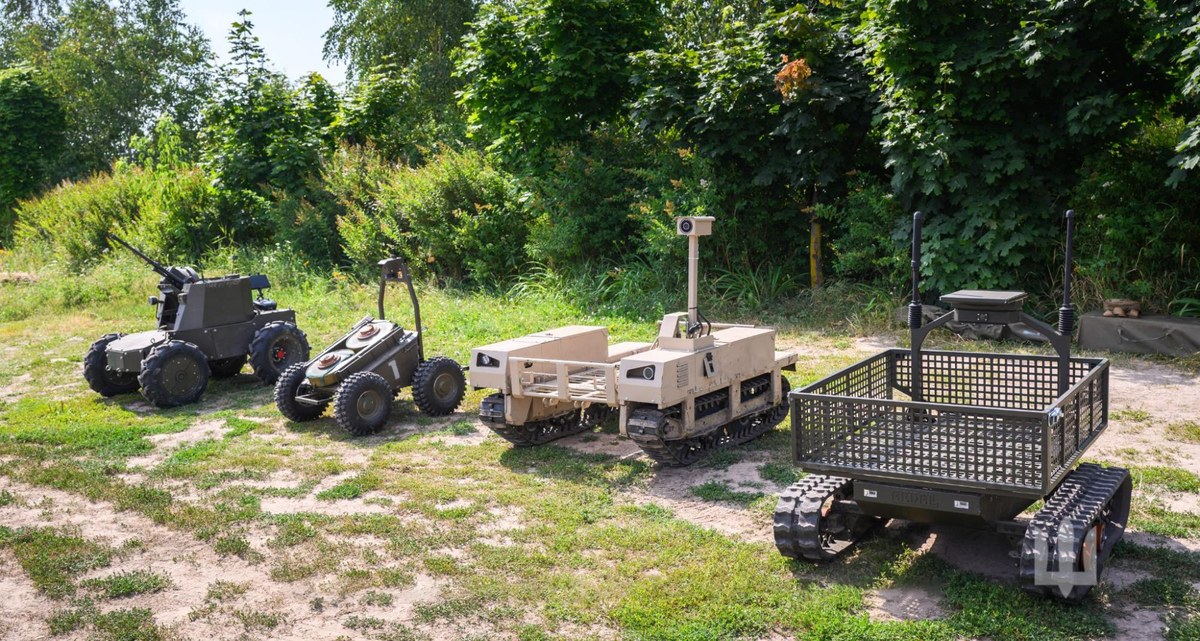
By type of NRC, we can divide them into what their chassis is built on. These can be tracked or wheeled robots. Most NRCs use batteries for power, but there are also variants with diesel engines, which are faster, but at the same time less resistant to direct hits. Which complex the military chooses depends on the task and conditions on the battlefield.
If there is a need for fast logistics, wheeled NRCs with an internal combustion engine are mainly used; for difficult terrain, caterpillars are better suited.
The military notes that one of the priorities when choosing an NRC is its modularity. In essence, the developers provide a base on which the military already puts the solutions they need for a specific combat mission. For example, the basic platform of the NRC ” Murakha ” can be retrofitted with various modules – from the combat turret “Mantis” to the relay mast ” Ivy “. The company is also currently working on a module for multiple-barrel mortar fire, which gives the military flexibility and the ability to adapt the machine to specific tasks.
According to their functional purpose, the NRC in the Armed Forces of Ukraine can be classified into several types, each of which performs specific tasks:
Combat (strike) systems: Armed platforms designed to provide infantry cover fire or direct strikes on enemy positions. Examples include the Lut NRC or the integration of the Ukrainian Burya combat module from Frontline onto the THeMIS platform.
Logistics complexes: Small semi-autonomous vehicles for transporting cargo such as ammunition, fuel, provisions, to the front line or between units. This is the basic function of a ground drone, and it is in this niche that the greatest successes have been achieved.
Evacuation complexes: Robotic stretchers on wheels or tracks that remove the wounded from “red zones” (including minefields), minimizing the risk to medics.
Engineer (sapper) complexes: Equipped with tools for demining or laying anti-personnel mines. An example is the “Gnome Miner”. They can pave corridors for infantry or lay minefields.
Reconnaissance complexes: Small maneuvering robots with cameras and sensors that work in tandem with UAVs, performing the functions of “robot eyes” for observation and compensating for the weak field of view of ground vehicles.

The Commander of the Ground Forces of the Armed Forces of Ukraine, Volodymyr Rovensky, said that 47% of the NRC missions are for logistical and evacuation tasks, about 25% for engineering (mining/demining), approximately 12% for combat, and the rest for special missions.
These statistics are confirmed by Igor Chaykivsky, founder of the company “Robotized Complexes”, who explained to dev.ua that the first area of application of NRCs at the front was logistics, since this is the most understandable and easiest segment for production.
Ukrainian NRC market
As in the case of UAVs, which proved their effectiveness in combat conditions, which gave impetus to local manufacturers to develop new solutions, NRCs also followed this path. As soon as NRCs began to attract attention from the military, this direction began to receive orders from the state. In the first quarter of 2025 alone, the Defense Procurement Agency (DPA) purchased more than 8,000 robots. In total, the state plans to order 15,000 NRCs this year, which is 15 times more than last year.
According to the Minister of Digital Transformation, Mykhailo Fedorov, 200 companies in Ukraine are working on the production of robots, and more than 40 developments are codified according to NATO standards.
In 2022, one of the first ground robots to be used in Ukraine was the THeMIS drones from Estonian Milrem Robotics. The company, considered one of the key European developers of NRC, emphasized that Ukraine has many leading specialists in this sector.
“The speed and ingenuity of Ukrainian engineers are impressive. Many teams are quickly adapting to the needs of the front. Some solutions are still in the early stages, but others already demonstrate significant potential for integration into more complex architectures. Ukraine has already established itself as a key player in combat robotics,” Mykyta Makushyn, head of the Milrem Robotics representative office in Ukraine, told dev.ua.
Among Ukrainian NRC developers, the Tencore company, founded in February 2024, has already assembled the first 10 TerMIT combat robots in a month. By the end of the year, the plans are to produce 2,000 machines. At the same time, in an interview with dev.ua, Tencore CEO Maksym Vasylchenko noted that there are five powerful NRC manufacturers in Ukraine, but companies working on the country’s defense are currently only 40% loaded. In addition, the head of Tencore criticized foreign NRCs, which are often too expensive or do not meet the realities of war.
Despite the competition, both Milrem Robotics and Tencore are successfully cooperating with Ukrainian weapons manufacturers. Frontline has integrated the Burya remotely controlled turret into the products of both companies.
How many NRCs are needed for the front?
Tencore co-founder and director Maksym Vasylchenko stated that “to cover the need on the front line, 40,000 robots are needed.” This figure is based on a brainstorming session with one military unit to support all units in Ukraine.
Milrem Robotics considers this estimate ambitious, but not unrealistic, considering all types of robotic platforms: logistics, surveillance, demining, fire support, medevac. 40,000 robots by themselves do not guarantee success. They need to be integrated into the force structure and the concept of warfare of the Armed Forces of Ukraine.
“Robotic Complexes” also responded with restraint about specific figures, the company noted that it is actually impossible to predict.

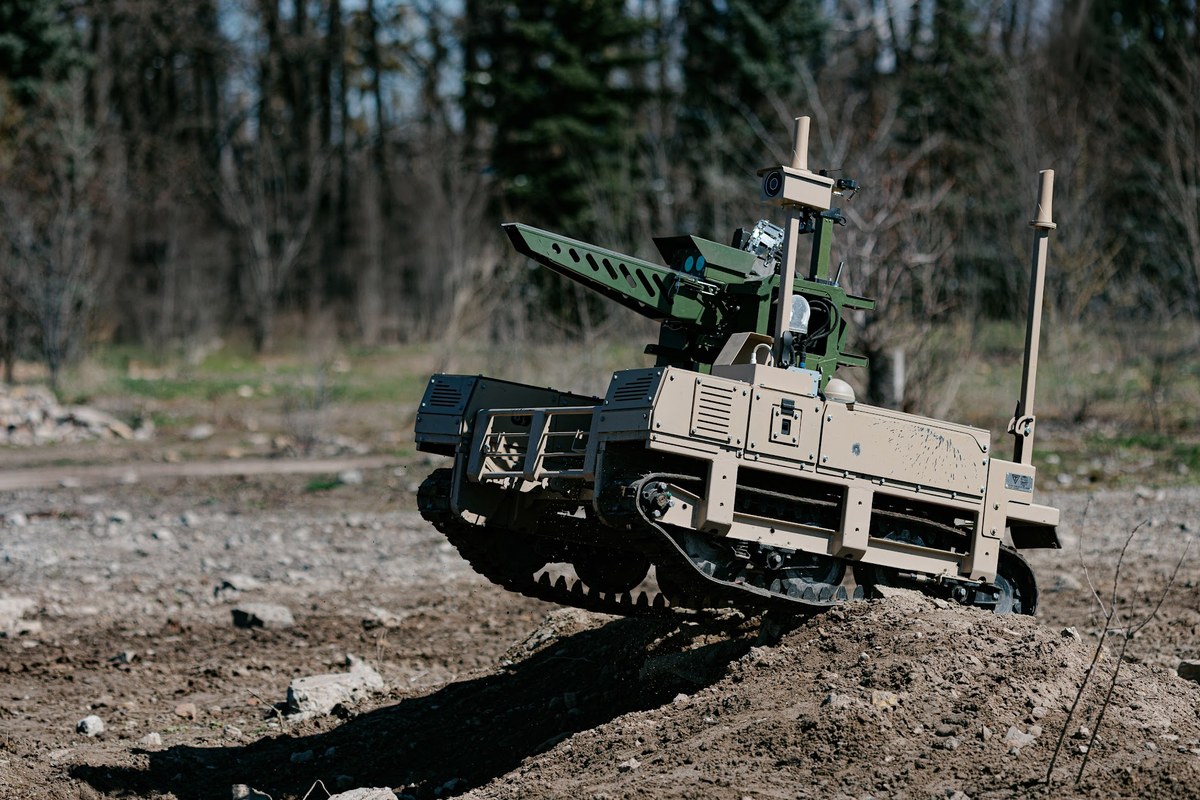
A serviceman with the call sign Banker, who is involved in the development of the Maul NRC, agrees that a lot of NRCs are needed, he explains the high need by the intensity of hostilities and the high level of vehicle losses: “You went out once, you were lucky, you were not seen, and the second time you went out, you were already seen 100%. And that’s, well, one or two trips.” This indicates a high utilization rate and potential loss of units.
Noise from the 301st separate regiment of the 3rd army corps confirms the realism of 40,000 NRKs, but clarifies that this is only for ground-based complexes. For a comprehensive solution to the front problem, which includes drones-relays and reconnaissance drones
“We need comprehensive solutions. And these comprehensive solutions have an approximate cost, which our commander Andriy Biletsky announced, which is over $2 billion.” He emphasizes that such a decision requires political will and the response of the General Staff.
Challenges
Despite significant successes, the Ukrainian NRC market is at an early stage of development. All the military personnel we spoke with say that the key challenge is communication and liaison. dev.ua wrote about this challenge two years ago, and although the situation is much better now, there is still room for developers to grow. Currently, the vast majority of NRCs operate in tandem with drones, which provide visual information and allow for effective control of platforms from safe positions.
Most NRCs use wireless communication, which on the one hand completely protects the operator, since he can control the robot from anywhere in the world, on the other hand, requires additional involvement of UAV operators, on which are located repeaters that transmit a signal to the NRC. Serviceman Shum told dev.ua that in general, the crew of one NRC can consist of up to 10 people.
“As a rule, the NRC crew includes: several operators, a crew commander, who is generally responsible for organizing this process, a signalman with telecommunications skills, and, of course, minimal engineering support,” said the scout of the Third Army Corps.
Shum also said that often the NRCs that were hit themselves evacuate other NRCs, which involves at least two crews, not including the UAV pilots, who have their own separate crews. During combat missions, one of the operators directly controls the ground robot, while the other is engaged in defeating the enemy by controlling the turret or any other firepower.
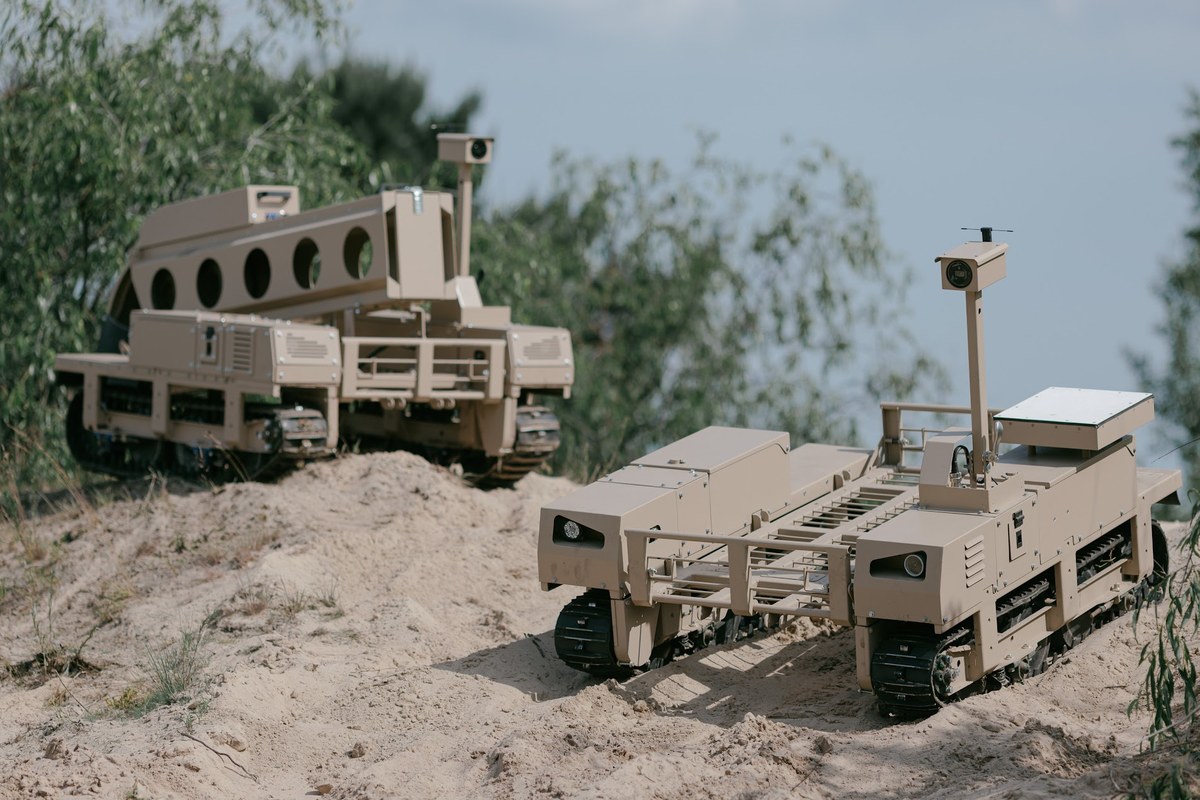
Chaykivskyi adds that the biggest challenge in this case is coordinating actions between those who manage the NRC remotely and the military directly on the ground, who make operational decisions.
“With certain communication configurations, it is already possible to operate a drone at a distance of hundreds of kilometers, if there is a satellite channel. At the same time, there are technical limitations: the machines are not yet capable of covering such distances on their own. They need to be charged and equipped not far from the line of contact. For the success of missions, the work of not only operators, but also support personnel is important,” added the head of Robotic Complexes.
Less common is the use of fiber optics for communication with the NRC. In this case, the signal is clearer, there is no need to involve drones for relaying, but the NRC operator must be located several kilometers from the LBZ.
What’s next?
The development of NRC is not only about technology, but also about changing the tactics of warfare. The deeper these systems are integrated into the structure of the Armed Forces of Ukraine, the more effectively they will be able to perform tasks – from logistics to complex assault operations, including as a means of short-range air defense.
The state has now stepped up funding for various programs for the development of ground robotic platforms. New grants from the Brave1 defense cluster provide for funding for programs for the NRC in the amount of up to 8 million hryvnias.
The government also approved amendments to Resolution No. 1129 and opened the market for training for NRC and water drone operators. It provides that military personnel will be able to receive certified training in private schools at state expense, as has been done for UAV pilots.
Meanwhile, private drone operator schools have repeatedly complained about insufficient funding, forcing them to cut pilot training programs .
Igor Chaykivskyi notes that operating an NRK is not difficult, and basic skills can be acquired in a few hours, especially if the serviceman has experience working with similar equipment or basic technical knowledge. According to Chaykivskyi, more time in training should be devoted to maintenance and proper operation of the machine.
Despite initial skepticism, ground robots have evolved from an experimental tool into an integral element of every frontline operation.
As Ragnar Sass, co-founder of the Estonian Darkstar Foundation, whose coworking space was hit by a Russian missile attack last week, recently said : “The first phase of robotic warfare has already begun — in Ukrainian skies, on land, and at sea.” And it is Ukraine that can set new standards for the world in the use of ground-based unmanned systems.
link