


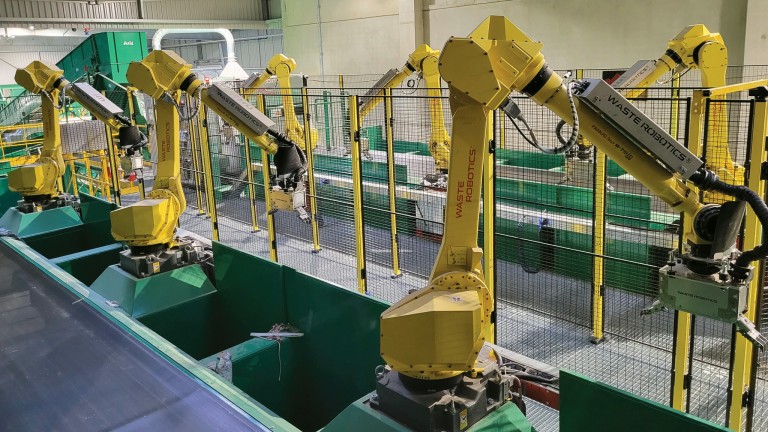
Waste Robotics delivers systems optimized for specific challenges like picking out rigid plastic, sorting C&D debris, or recovering metals.
Courtesy of Waste Robotics
The gripper advantage
Much of Waste Robotics’ differentiation lies in its use of advanced gripping systems over traditional suction cups. While suction-based sorters work well on flat, lightweight items by targeting the material’s centre of mass, they struggle with irregular, three-dimensional, or heavy objects. Grippers, by contrast, can handle more complex shapes and weights, but they also demand more sophisticated collision avoidance, especially when reaching into a cluttered pile.
“A lot of AI [is needed] to figure out how to position the hand to go through a pile of something to grab what you want,” says Camirand. “From a computational standpoint, it’s way more involved than having the suction cup.”
The company’s early work in bag sorting laid the foundation for its move into C&D applications, plastics, and now, scrap metal. Most recently, Waste Robotics entered the scrap metal sector with a system designed to extract copper windings, commonly referred to as “meatballs,” from the ferrous stream.
“It’s not only the tool at the end of the robot that changed, but it’s also this . . . ‘gripper AI,'” Camirand explains.
While the attachment varies, the system’s core platform remains unchanged. Some lines even deploy both grippers and suction cups, with the software system dynamically dispatching to the right tool based on object properties. Items like circuit boards can be picked with suction, while bulky or non-uniform objects are routed to the gripper, allowing for more dynamic and accurate sorting across varied streams.
Adapting in real time
Waste Robotics’ systems are not only tailored to each client, they’re also flexible in day-to-day operation. Operators can program robots for either positive or negative sorting based on incoming materials.
“Most of these [traditional] machines will do the same thing day one and 10 years down the road,” says Camirand. But with Waste Robotics, AI helps the machines evolve over time. They can be programmed to switch between tasks with ease, and also to learn and grow as a client’s needs and operations evolve. “You basically have a captive workforce that you can deploy to do whatever you want it to do.”
This versatility is particularly valuable in smaller or medium-sized facilities where feedstock composition changes frequently. A load of mostly clean wood in the morning might require negative sorting; a mixed-material pile that arrives later could call for targeted positive recovery. Unlike legacy machinery, Waste Robotics’ systems can respond to these changes without physical retrofitting, just reprogramming.
Gripper AI must evaluate hundreds of possible grip points in real time, balancing object shape, surrounding materials, and collision risk. This level of precision demands advanced computing power to ensure safe, accurate, and efficient picking.
That same adaptability applies to long-term upgrades. AI models improve over time. Grippers can be swapped or refined. Entire recipes for sorting logic can be reconfigured to accommodate changing materials or customer priorities.
Making data actionable with Greyparrot
Waste Robotics’ partnership with Greyparrot brings even more intelligence to the table. Greyparrot’s AI-powered analyzers provide real-time visibility into material streams, capturing detailed data for waste composition, volume, and flow.
This information helps eliminate the guesswork from system design. Instead of estimating robot performance based on a short observation window, Waste Robotics can now simulate months of plant activity using actual data.
By combining Greyparrot’s analytics with its own robotic simulation platform, internally referred to as the “robot validator,” Waste Robotics can test different configurations, product targets, and ROI scenarios before anything is built.
“When we design a robotic solution, we [can] tell the client, ‘It’s going to be 32.5 picks [per minute] based on six months of data,'” says Camirand. “Now we [can] have an intelligent conversation.” It’s a shift from generalized performance claims to data-backed precision.
And it’s not just about optimizing robots. The integration of visual AI also allows for continuous plant feedback. With the right infrastructure, operators could one day adjust conveyors, screens, or robotic parameters in real time based on automated observations.
“This is not a fad,” says Camirand. “We can mine this data to get knowledge and do better jobs. Now we have the tools to actually build the MRF of the future.”
link