Fingerprint Biometric Technology Market | Global Market Analysis Report

Fingerprint Biometric Technology Market Forecast and Outlook 2025 to 2035
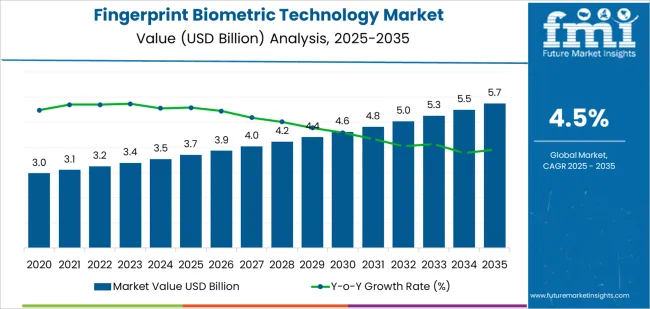
The global fingerprint biometric technology market is valued at USD 3.7 billion in 2025 and is projected to reach USD 5.8 billion by 2035, reflecting a CAGR of 4.5%. The acceleration phase of the market occurs in the early years, between 2025 and 2030, driven by the increasing adoption of fingerprint-based authentication across mobile devices, government identification systems, and financial services. As security concerns rise and the demand for seamless, secure access solutions grows, fingerprint biometric systems gain widespread usage. This period experiences an upward surge in growth as fingerprint sensors become a core component in smartphones, tablets, laptops, and other connected devices, propelled by consumer demand for more secure and convenient ways to authenticate identity.
After 2030, the market enters a deceleration phase as growth begins to moderate. The acceleration slows down as fingerprint biometrics become ubiquitous, and the technology reaches saturation in key consumer electronics and security applications. By this point, nearly all smartphones, tablets, and laptops have integrated fingerprint scanning, and the technology is well-established in government and financial sectors. However, the deceleration is softened by innovations such as multi-modal biometric systems and new applications in access control, healthcare, and IoT security, which provide continued, though more gradual, growth toward 2035.
Quick Stats for Fingerprint Biometric Technology Market
- Fingerprint Biometric Technology Market Value (2025): USD 3.7 billion
- Fingerprint Biometric Technology Market Forecast Value (2035): USD 5.8 billion
- Fingerprint Biometric Technology Market Forecast CAGR (2025–2035): 4.5%
- Leading Segment in Fingerprint Biometric Technology Market (2025): In-screen Fingerprint Recognition (47.0%)
- Key Growth Regions in Fingerprint Biometric Technology Market: China, India, Germany, Brazil
- Top Players in Fingerprint Biometric Technology Market: Qualcomm, Fingerprint Cards, Synaptics, Japan Display, Goodix Technology, Egis Technology, Beijing GigaDevice, Shanghai OXi Technology, Focaltech Electronics, VKANSEE
What is the Growth Forecast for the Fingerprint Biometric Technology Market through 2035?
Between 2025 and 2030, the Fingerprint Biometric Technology Market grows from USD 3.7 billion to USD 4.8 billion, generating USD 1.1 billion in additional value. The market shows consistent growth, with annual increases ranging from USD 0.2 billion to USD 0.3 billion each year. Over this period, market share gain is driven by higher adoption of fingerprint biometric systems in mobile devices, security applications, and government identification programs. The trend toward contactless solutions and integration of fingerprint sensors in emerging technologies (such as smart locks, wearables, and IoT devices) further supports this growth, with new applications boosting overall demand.
From 2030 to 2035, the market expands from USD 4.8 billion to USD 5.8 billion, adding USD 1.0 billion in value. During this phase, market share erosion is expected from alternative biometric technologies, especially facial recognition and iris scanning technologies, which increasingly compete with fingerprint biometrics in some sectors due to their non-contact capabilities. However, fingerprint biometrics will continue to capture strong growth in high-security applications and industries focused on affordability and convenience. Fingerprint biometric technology will maintain its market position by innovating with multi-modal biometric solutions and enhancing sensor accuracy, user convenience, and processing speed, ensuring continued market share gain in applications that require high security and precision, like banking, healthcare, and law enforcement.
Fingerprint Biometric Technology Market Key Takeaways
| Metric | Value |
|---|---|
| Market Value (2025) | USD 3.7 billion |
| Market Forecast Value (2035) | USD 5.8 billion |
| Forecast CAGR (2025–2035) | 4.5% |
Why Is the Fingerprint Biometric Technology Market Growing Across Corporate, Consumer, and Government Sectors?
The fingerprint biometric technology market is growing as organizations and device manufacturers expand deployment of fingerprint based systems for access control, identity authentication, and transaction approval. Demand increases because fingerprint recognition is relatively mature, cost effective, and widely accepted compared to newer modalities. It is embedded in smartphones, payment systems, border control kiosks, workforce attendance systems, and smart home devices, strengthening utility across applications. Hardware improvements such as capacitive, optical, and ultrasonic sensors enhance accuracy even under challenging conditions. Research also explores contactless and multi finger fingerprint solutions that boost reliability and hygiene. Growing regulatory demands for secure authentication, along with rising digital payments and remote identity use cases, further drive adoption across consumer electronics, enterprise IT, and public sector infrastructure.
Market expansion is also supported by regional growth in Asia Pacific and increasing government identity program roll outs in emerging countries, creating large volume potential. Vendors refine software layers, cloud based management, and integration with broader authentication frameworks (multi factor, multimodal) to add value. Although competition from alternative biometric modalities (facial, iris, vein) and privacy regulation concerns remain headwinds, the established ecosystem for fingerprint technology including standards, supply chains, and user familiarity supports continued growth. Overall, as digital transformation deepens and identity verification becomes more critical, fingerprint biometric technology remains a cornerstone solution with broad market potential.
How Do Fingerprint Recognition Types and Application Areas Shape Segmentation in the Fingerprint Biometric Technology Market?
The fingerprint biometric technology market is segmented by type, application, and region. By type, the market includes in-screen fingerprint recognition and under-screen fingerprint recognition. Based on application, it is categorized into smartphone, tablet, smart door lock, and others. Regionally, the market is segmented into North America, Europe, East Asia, South Asia, Latin America, and the Middle East & Africa. These divisions reflect differing technological adoption rates, consumer preferences, and security needs across various sectors and regions.
What Factors Support the Leading Position of In-screen Fingerprint Recognition in the Market?
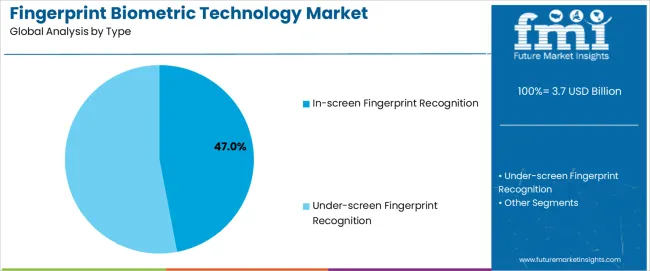
The in-screen fingerprint recognition segment accounts for approximately 47.0% of the global fingerprint biometric technology market in 2025, making it the leading type category. This position is driven by the increasing integration of fingerprint sensors within smartphone displays, allowing for a sleek, seamless user experience that aligns with the trend of maximizing screen space. In-screen sensors also provide enhanced security features by enabling users to unlock devices, authenticate payments, and access apps directly through the screen without needing physical buttons or external sensors.
In-screen fingerprint recognition is particularly popular in premium and mid-range smartphones, where manufacturers are prioritizing both aesthetics and functionality. The technology has gained strong adoption in North America, East Asia, and Europe, where smartphone penetration is high, and consumers demand advanced security features. The segment maintains its lead because it delivers an efficient, user-friendly experience and meets the growing demand for high-performance biometric systems in personal devices. As mobile devices continue to evolve, in-screen fingerprint recognition remains at the forefront due to its seamless integration and ability to provide high-level security within a compact design.
Why Does the Smartphone Application Represent the Largest Share in the Fingerprint Biometric Technology Market?
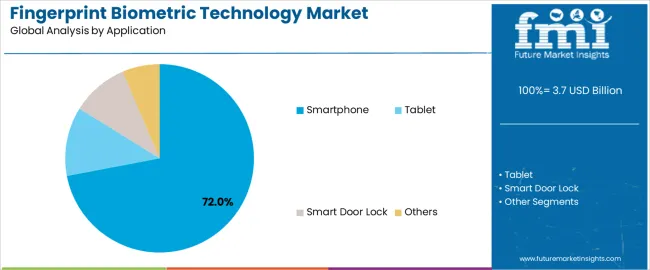
The smartphone segment represents about 72.0% of the total fingerprint biometric technology market in 2025, making it the dominant application category. This position is supported by the rapid adoption of biometric authentication as a standard feature in smartphones for security purposes, including device unlocking, mobile payment authentication, and app access control. The shift towards contactless technologies and the increasing importance of securing personal information in mobile devices have made fingerprint biometrics a highly sought-after feature.
Adoption is particularly strong in East Asia, North America, and Europe, where smartphone manufacturers have consistently integrated advanced fingerprint recognition systems into their devices to meet consumer demand for more secure and efficient unlocking methods. As smartphones become increasingly essential for daily activities, from communication to financial transactions, the demand for secure, reliable, and fast biometric solutions continues to grow. The smartphone segment retains its leading position because it represents the most prominent consumer use case for fingerprint recognition technology, driving both volume and innovation in the broader biometric technology market.
What are the Key Trends, Drivers, and Restraints in the Fingerprint Biometric Technology Market?
The fingerprint biometric technology market is expanding as demand for robust identity verification and authentication grows across consumer devices, enterprise access control and public security applications. Fingerprint biometrics remains one of the most mature and widely deployed modalities due to its high accuracy, user convenience and cost effectiveness. Growth is supported by increasing use in smartphones and wearable devices, strong government initiatives for digital identity programs and growing adoption in banking and payments. Adoption is moderated by concerns around data privacy, spoofing risks, and the shift toward multimodal and contactless biometric methods. Industry players are developing advanced sensors (ultrasonic, in display), cloud based analytics and liveness detection to maintain relevance in evolving environments.
How are mobile devices, payments and digital identity programs driving fingerprint biometric adoption?
Demand is being fuelled by the ubiquity of smartphones and mobile banking, where fingerprint sensors are often integrated for device unlock and secure transactions. Financial services and fintech companies increasingly require strong authentication methods to comply with regulatory standards and reduce fraud. Government digital ID schemes in many countries employ fingerprint recognition for enrolment and verification, making fingerprint biometric components and systems essential infrastructure. As digital services expand, fingerprint biometric technology provides a familiar and trusted authentication layer across consumer, enterprise and public sector contexts.
What factors are limiting wider deployment of fingerprint biometric systems?
Several barriers inhibit broader uptake of fingerprint biometric technology. Privacy and data security concerns are significant: fingerprint data is highly sensitive and cannot be ‘reset’ like a password if compromised. Some users and regulatory jurisdictions raise concerns about collection, storage and use of biometric data. Technological limits such as sensor reliability on dirty or worn fingertips, spoofing vulnerability, and user perception of hygiene (especially in contact based systems) also reduce adoption in some settings. The emergence of alternatives such as face or iris recognition may displace or reduce the role of fingerprint biometrics in certain applications.
What trends are shaping the evolution of fingerprint biometric technology?
Key trends include advancement of in display and under glass fingerprint sensors in smartphones, ultrasonic and optical sensors that work through protective screen layers, and contactless fingerprint capture (for hygiene or wearable uses). There is growing integration of liveness detection and AI driven analytics to reduce spoofing risk and support multimodal authentication architectures (e.g., fingerprint + face). Enterprise and public sector users are increasingly adopting cloud based biometric as a service (BaaS) models for scalability and ease of deployment. Regionally, Asia Pacific is emerging as a high growth zone driven by smartphone penetration and national ID programs, while North America and Europe continue to focus on enterprise and border control applications.
What is the Analysis of the Fingerprint Biometric Technology Market by Key Country?
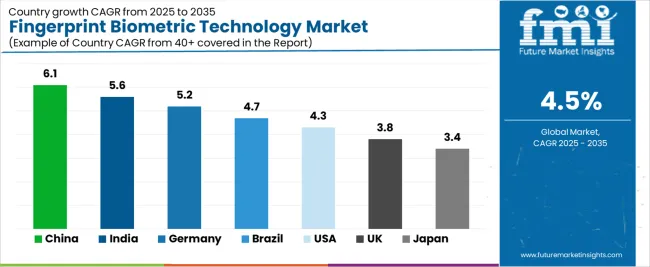
| Country | CAGR (%) |
|---|---|
| China | 6.1% |
| India | 5.6% |
| Germany | 5.2% |
| Brazil | 4.7% |
| USA | 4.3% |
| UK | 3.8% |
| Japan | 3.4% |
The Fingerprint Biometric Technology Market is expanding steadily across global security and identification sectors, with China leading at a 6.1% CAGR through 2035, driven by widespread adoption of fingerprint-based security systems in mobile devices, government services, and access control applications. India follows at 5.6%, supported by increasing use of biometric authentication in banking, e-commerce, and government initiatives. Germany records 5.2%, reflecting strong regulatory frameworks, high security standards, and growing demand for biometric solutions in enterprise security systems. Brazil grows at 4.7%, driven by the rise in digitalization, financial inclusion, and mobile payments, which rely on biometric verification. The USA, at 4.3%, remains a mature market emphasizing innovation in secure biometric systems for both consumer and enterprise applications, while the UK (3.8%) and Japan (3.4%) focus on advanced integration in mobile, healthcare, and law enforcement sectors.
How Is Security Demand Driving Growth in China?
China is projected to grow at a CAGR of 6.1% through 2035 in the fingerprint biometric technology market. Increasing concerns over data security and the rise of digital identification solutions boost the demand for fingerprint biometric technology. Financial institutions, government bodies, and tech companies adopt biometric systems to enhance security in mobile devices, banking transactions, and national ID programs. Manufacturers focus on improving the speed, accuracy, and cost-effectiveness of fingerprint sensors. The growing use of biometric authentication in consumer electronics and access control systems further drives market growth across various industries.
- Increased demand for digital security drives adoption of biometric authentication.
- Mobile devices and banking sectors increasingly rely on fingerprint technology.
- Biometric sensors offer enhanced accuracy, security, and user convenience.
- Government ID programs and access control systems expand fingerprint technology usage.
Why Are Digital Authentication Needs Supporting India’s Market?
India is projected to grow at a CAGR of 5.6% through 2035 in the fingerprint biometric technology market. The rising adoption of digital identification systems in financial services, mobile applications, and government services drives the demand for fingerprint biometrics. Local manufacturers and service providers focus on providing low-cost, reliable fingerprint scanning solutions suitable for various industries. Government initiatives, such as digital India programs, support the integration of biometric systems for online services. The increasing demand for secure, user-friendly authentication systems in e-commerce and mobile banking further accelerates market expansion.
- Digital India initiatives promote the use of biometric authentication systems.
- Financial services, mobile apps, and government services increase fingerprint adoption.
- Low-cost, reliable solutions drive market penetration across various sectors.
- The growth of mobile banking and e-commerce accelerates biometric technology use.
How Are Security Standards Influencing the Market in Germany?
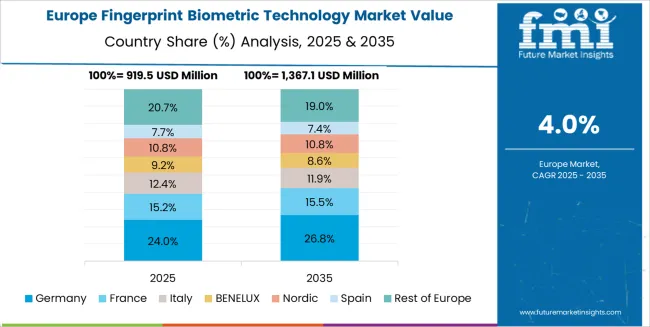
Germany is projected to grow at a CAGR of 5.2% through 2035 in the fingerprint biometric technology market. Strict regulations around data security and privacy laws, such as the GDPR, drive demand for biometric authentication technologies. The growing use of fingerprint recognition for access control, secure payment systems, and employee identification in corporate settings further contributes to market growth. Manufacturers are focused on developing advanced fingerprint sensors that offer high precision, faster recognition, and improved resistance to spoofing attacks. The adoption of biometric solutions across multiple sectors, including finance and healthcare, accelerates market demand.
- GDPR-driven security regulations increase the demand for biometric systems.
- Fingerprint recognition ensures secure payments and access control across industries.
- High-precision sensors improve user experience and security levels in applications.
- Biometric solutions expand across sectors like finance, healthcare, and retail.
How Are Digital Payments and Security Policies Driving Brazil’s Market?
Brazil is projected to grow at a CAGR of 4.7% through 2035 in the fingerprint biometric technology market. The growth of digital payments, e-commerce, and mobile banking in Brazil drives the adoption of biometric technologies for secure transactions. Biometric authentication is increasingly used in financial services, government programs, and mobile apps to enhance user security and prevent fraud. Manufacturers are focusing on developing affordable, reliable biometric solutions tailored to Brazil’s unique market conditions. Government initiatives to digitise public services and enhance security further contribute to the rising demand for fingerprint-based systems.
- Digital payments and e-commerce boost the demand for secure biometric systems.
- Mobile banking, apps, and government services expand fingerprint technology adoption.
- Affordable, reliable solutions drive biometric system usage in Brazil’s economy.
- Government initiatives support the expansion of biometric authentication systems.
How Are Mobile Security and Identification Needs Supporting the USA Market?
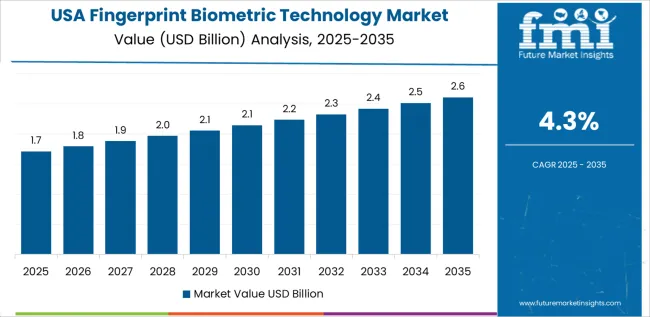
USA is projected to grow at a CAGR of 4.3% through 2035 in the fingerprint biometric technology market. Mobile security, online identity verification, and secure payments drive the need for fingerprint biometrics in the USA. Biometric solutions are increasingly integrated into smartphones, laptops, and access control systems to enhance security and streamline authentication processes. The financial and healthcare sectors contribute significantly to the market, implementing fingerprint-based verification systems to safeguard sensitive data. With the rise of digital fraud, companies continue to invest in more secure, convenient, and scalable biometric solutions for end-users.
- Mobile security needs drive increased adoption of fingerprint authentication.
- Financial and healthcare sectors implement biometric verification to safeguard data.
- Biometric solutions improve user experience and authentication convenience in devices.
- Secure, scalable solutions reduce digital fraud risks across industries.
Why Are Privacy Concerns Supporting the UK Market?
UK is projected to grow at a CAGR of 3.8% through 2035 in the fingerprint biometric technology market. Growing concerns over digital privacy and the need for secure personal identification solutions drive the demand for biometric systems. UK businesses and government agencies increasingly adopt fingerprint biometric technology for secure access to digital services and facilities. Privacy protection regulations, such as GDPR, promote the use of secure, non-invasive authentication methods. The integration of biometric solutions in mobile banking, payment systems, and national identity programs also boosts market demand, especially in urban areas.
- Digital privacy concerns accelerate the adoption of secure biometric systems.
- GDPR regulations promote the use of secure fingerprint authentication.
- Biometric systems integrate with mobile banking and payment solutions.
- The adoption of fingerprint technology expands in national identity programs.
How Are Security Needs and Technological Advancements Shaping Japan’s Market?
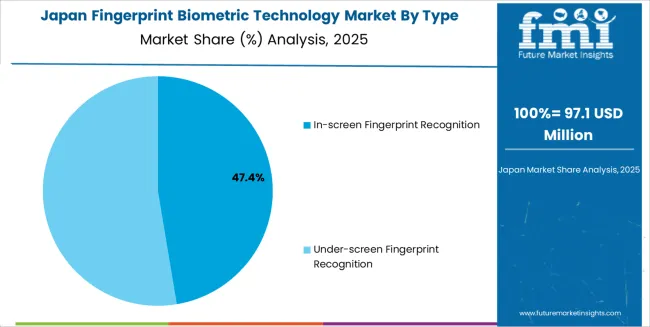
Japan is projected to grow at a CAGR of 3.4% through 2035 in the fingerprint biometric technology market. Rising concerns about digital security and the increasing use of mobile payments drive the demand for fingerprint authentication systems in Japan. Biometric technology is integrated into smartphones, laptops, and government-issued identification cards for secure access. The Japanese government’s push for digital transformation in public services accelerates the adoption of fingerprint-based systems for identification and authentication purposes. Technological advancements in sensor technology and the increasing integration of AI for biometric systems further enhance the growth of the market.
- Mobile payment growth increases the need for secure biometric authentication.
- Digital transformation drives government adoption of fingerprint-based systems.
- Advancements in sensor technology enhance the security and accuracy of systems.
- AI integration optimises fingerprint recognition and enhances user experience.
How Competitive Is the Global Fingerprint Biometric Technology Market and What Defines Its Strategic Landscape?
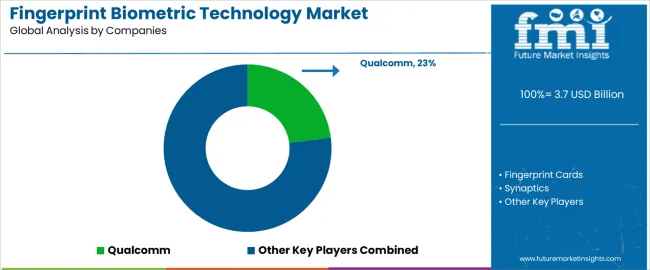
The global fingerprint biometric technology market is moderately competitive, shaped by companies providing advanced fingerprint sensors and biometric solutions for mobile devices, security systems, and access control applications. Qualcomm, Fingerprint Cards, and Synaptics hold leading positions by offering high-performance fingerprint sensors integrated into smartphones, tablets, and laptops, with innovations focused on accuracy, speed, and integration with next-gen mobile and smart devices. Japan Display and Goodix Technology strengthen the market by providing optical and capacitive fingerprint sensors designed for a wide range of consumer electronics, including wearables and laptops. Egis Technology and Beijing GigaDevice expand the market with specialized sensors used in mobile devices, IoT applications, and secure identification solutions.
Shanghai OXi Technology, Focaltech Electronics, and VKANSEE contribute to the market by delivering cost-effective fingerprint sensor solutions for emerging markets, offering both capacitive and optical fingerprint sensors suitable for mid-range devices. Competition across this market is influenced by sensor performance, ease of integration, and the ability to meet security standards, especially in mobile and financial transactions. Strategic differentiation depends on innovations in sensor miniaturization, multi-modal biometric integration, and enhanced security features such as liveness detection. As the demand for secure authentication methods continues to rise in consumer devices and public security applications, companies offering scalable, high-accuracy, and easily integrated biometric solutions are well-positioned to maintain a competitive edge.
Key Players in Fingerprint Biometric Technology Market
- Qualcomm
- Fingerprint Cards
- Synaptics
- Japan Display
- Goodix Technology
- Egis Technology
- Beijing GigaDevice
- Shanghai OXi Technology
- Focaltech Electronics
- VKANSEE
Report Scope for Fingerprint Biometric Technology Market
| Items | Values |
|---|---|
| Quantitative Units (2025) | USD billion |
| Type | In-screen Fingerprint Recognition, Under-screen Fingerprint Recognition |
| Application | Smartphone, Tablet, Smart Door Lock, Others |
| Regions Covered | East Asia, Europe, North America, South Asia, Latin America, Middle East & Africa |
| Countries Covered | China, India, Germany, Brazil, USA, UK, Japan, and 40+ additional countries |
| Key Companies Profiled | Qualcomm, Fingerprint Cards, Synaptics, Japan Display, Goodix Technology, Egis Technology, Beijing GigaDevice, Shanghai OXi Technology, Focaltech Electronics, VKANSEE |
| Additional Attributes | Dollar sales by type and application, advancements in fingerprint sensor technology (capacitive, optical, ultrasonic), regulatory compliance (GDPR, privacy concerns), sensor reliability under challenging conditions, multi-modal biometric solutions, integration with mobile, IoT, healthcare, and security systems, contactless solutions, AI integration in biometric systems. |
Fingerprint Biometric Technology Market Segmentation
Type:
- In-screen Fingerprint Recognition
- Under-screen Fingerprint Recognition
Application:
- Smartphone
- Tablet
- Smart Door Lock
- Others
Region:
- East Asia
- China
- Japan
- South Korea
- Taiwan
- Rest of East Asia
- Europe
- Germany
- UK
- France
- Italy
- Spain
- Switzerland
- Nordic
- BENELUX
- Rest of Europe
- North America
- South Asia
- India
- Pakistan
- Bangladesh
- Rest of South Asia
- Latin America
- Brazil
- Argentina
- Chile
- Rest of Latin America
- Middle East & Africa
- Kingdom of Saudi Arabia
- Other GCC Countries
- Turkey
- South Africa
- Other African Union
- Rest of Middle East & Africa
- Eastern Europe
- Russia
- Poland
- Czech Republic
- Rest of Eastern Europe
Frequently Asked Questions
How big is the fingerprint biometric technology market in 2025?
The global fingerprint biometric technology market is estimated to be valued at USD 3.7 billion in 2025.
What will be the size of fingerprint biometric technology market in 2035?
The market size for the fingerprint biometric technology market is projected to reach USD 5.7 billion by 2035.
How much will be the fingerprint biometric technology market growth between 2025 and 2035?
The fingerprint biometric technology market is expected to grow at a 4.5% CAGR between 2025 and 2035.
What are the key product types in the fingerprint biometric technology market?
The key product types in fingerprint biometric technology market are in-screen fingerprint recognition and under-screen fingerprint recognition.
Which application segment to contribute significant share in the fingerprint biometric technology market in 2025?
In terms of application, smartphone segment to command 72.0% share in the fingerprint biometric technology market in 2025.
link