Iris Biometrics Market Set to Surge as Contactless Security
Iris Biometrics Market
The iris biometrics market is witnessing a strong upward trajectory as organizations worldwide prioritize secure, contactless, and highly accurate identity authentication solutions. Iris recognition, known for its unmatched precision and resistance to spoofing, has evolved from niche security applications into a mainstream biometric technology adopted across government, banking, healthcare, and consumer electronics. The growing convergence of artificial intelligence (AI), computer vision, and advanced sensor technologies has further enhanced system performance, enabling faster identification even in high-traffic environments.
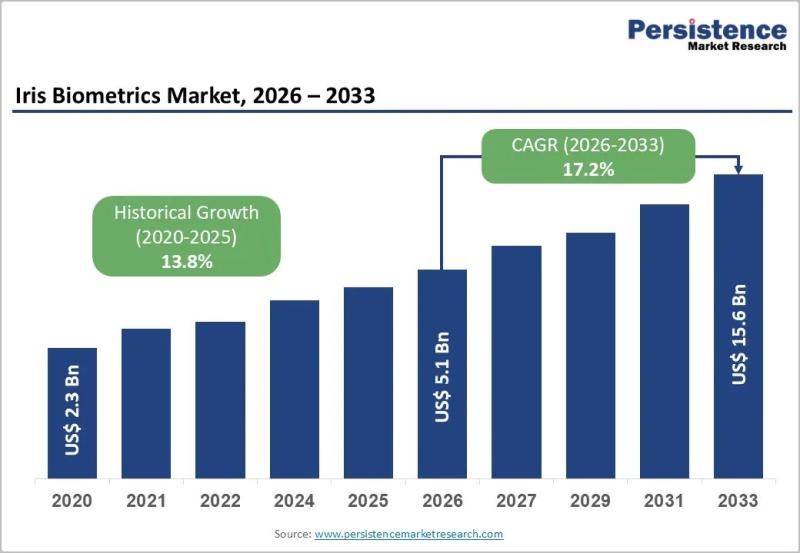
From a market size perspective, the global iris biometrics market is projected to grow from US$ 5.1 billion in 2026 to US$ 15.6 billion by 2033, registering a robust CAGR of 17.2% during the forecast period. This growth is underpinned by rising cybersecurity threats, large-scale government identity programs, and increasing adoption of contactless authentication following global health concerns. Hardware currently dominates the market due to demand for secure scanners, while software is emerging as the fastest-growing segment as organizations seek scalable, AI-powered solutions.
Elevate your business strategy with comprehensive market data. Request a sample report now
Key Growth Drivers, Leading Segments, and Regional Leadership
One of the primary growth drivers behind the iris biometrics market is the escalating need for high-assurance identity verification in critical infrastructure such as airports, borders, financial institutions, and government facilities. Compared to fingerprints or facial recognition, iris patterns offer higher stability over a lifetime, making them ideal for long-term identification programs. Government mandates for modernized border control, national ID systems, and digital citizenship initiatives are further accelerating adoption across developed and emerging economies.
In terms of segmentation, hardware leads the market with over 52% share in 2026, valued at more than US$ 2.7 billion, driven by the deployment of tamper-resistant iris scanners in secure environments. Access control remains the leading application, accounting for over 34% share, as enterprises demand fast and contactless entry solutions. Geographically, North America dominates the market with over 36% share, supported by advanced biometric infrastructure and strong government adoption, while Asia Pacific emerges as the fastest-growing region due to large population-scale identity programs and rapid digitization in BFSI and healthcare.
Key Highlights from the Report
The global iris biometrics market is projected to grow at a CAGR of 17.2% between 2026 and 2033.
Hardware remains the leading offering, accounting for more than half of total market revenue in 2026.
Cloud-based deployment is the fastest-growing model due to scalability and cost efficiency.
Government and public sector applications dominate adoption through national ID and border control projects.
North America leads the market, while Asia Pacific registers the highest growth rate.
AI integration is significantly improving accuracy, speed, and scalability of iris recognition systems.
Market Segmentation Analysis
The iris biometrics market can be segmented based on offering, deployment model, application, and end-user industry, each contributing uniquely to overall growth. By offering, the market is divided into hardware, software, and services. Hardware continues to generate the highest revenue due to widespread installation of iris scanners and cameras in high-security settings. However, software is gaining momentum as vendors introduce AI-driven algorithms that enhance matching accuracy, reduce false acceptance rates, and enable remote upgrades.
From an end-user perspective, the market spans government and public sector, BFSI, healthcare, defense, consumer electronics, and enterprise security. Government and public sector remains the largest end-user segment, driven by large-scale citizen enrollment programs, border management systems, and law enforcement databases. Meanwhile, BFSI is the fastest-growing segment as banks and fintech companies deploy iris biometrics for secure transaction authentication, fraud prevention, and compliance with stringent KYC and AML regulations.
Deployment Models and Application-Based Segmentation
Based on deployment, the market is categorized into on-premises and cloud-based solutions. On-premises deployment leads the market with over 48% share in 2026, as sensitive identity data requires high levels of control, privacy, and real-time processing. This model is particularly preferred by government agencies, defense organizations, and critical infrastructure operators. However, cloud-based deployment is witnessing rapid growth with a CAGR of 23.1%, fueled by its flexibility, lower upfront costs, and ease of integration with existing digital platforms.
Application-wise, iris biometrics is increasingly used across access control, time and attendance, transaction authentication, border control, and identity management systems. Access control dominates due to its widespread adoption in offices, airports, and restricted facilities. At the same time, transaction authentication is emerging as a high-growth application, especially in mobile banking and digital payments, where contactless and fraud-resistant verification is becoming essential.
Regional Insights: North America and Europe
North America continues to dominate the iris biometrics market due to early adoption of advanced security technologies and strong government investment in border control and homeland security. The region benefits from the presence of leading biometric solution providers, continuous R&D spending, and favorable regulatory frameworks that support digital identity initiatives.
Europe holds a significant share of the global market, driven by stringent data protection regulations such as GDPR and large-scale biometric deployments under border management systems like the Entry/Exit System (EES). Countries across Western and Northern Europe are increasingly adopting iris recognition to balance enhanced security with privacy compliance.
Regional Insights: Asia Pacific and Rest of the World
Asia Pacific is the fastest-growing regional market, registering a CAGR of 22.9%, supported by massive government-led identity programs in countries such as India, China, and Southeast Asian nations. Rapid digitization of banking services, growing healthcare infrastructure, and increasing urbanization are creating fertile ground for iris biometric adoption across both public and private sectors.
Other regions, including the Middle East, Africa, and Latin America, are also gaining traction as governments invest in smart city projects, national ID systems, and airport modernization. These regions present long-term growth opportunities as biometric infrastructure continues to expand.
Secure Your Full Report – Proceed to Checkout:
Market Drivers
The primary driver of the iris biometrics market is the growing demand for highly secure and contactless authentication solutions. Rising cybercrime, identity fraud, and data breaches have exposed the limitations of traditional authentication methods, prompting organizations to adopt more reliable biometric technologies.
Additionally, government initiatives for digital identity, border security modernization, and citizen services are accelerating large-scale deployments. The integration of AI and machine learning further enhances system accuracy and speed, making iris biometrics suitable for both high-volume and real-time applications.
Market Restraints
Despite strong growth prospects, the market faces certain restraints, including high initial implementation costs associated with specialized hardware and infrastructure. Small and medium-sized enterprises may find it challenging to justify these investments, particularly in cost-sensitive markets.
Privacy concerns and regulatory complexities also pose challenges, as biometric data is highly sensitive. Compliance with data protection laws and ensuring ethical use of biometric information require continuous investment in secure storage, encryption, and governance frameworks.
Market Opportunities
The market presents significant opportunities in the expansion of cloud-based and mobile iris biometric solutions, particularly for BFSI and consumer electronics applications. As smartphones and wearable devices integrate advanced cameras, iris recognition is poised to become a mainstream authentication feature.
Emerging markets offer untapped potential due to increasing government digitization initiatives and financial inclusion programs. Strategic partnerships between technology providers and public agencies can further accelerate adoption and market penetration.
Do You Have Any Query Or Specific Requirement? Request Customization of Report:
Reasons to Buy the Report
✔ Gain comprehensive insights into market size, growth trends, and future forecasts through 2033.
✔ Understand key drivers, restraints, and opportunities shaping the global iris biometrics industry.
✔ Identify high-growth segments and regions to support strategic investment decisions.
✔ Analyze competitive dynamics and positioning of leading market players.
✔ Access reliable data to support business planning, product development, and market entry strategies.
Frequently Asked Questions (FAQs)
How big is the global Iris Biometrics Market and how fast is it growing?
Who are the key players in the global Iris Biometrics Market?
What is the projected growth rate of the Iris Biometrics Market during the forecast period?
What is the market forecast for the Iris Biometrics Market by 2033?
Which region is estimated to dominate the iris biometrics industry through the forecast period?
Company Insights
Thales Group
IDEMIA
NEC Corporation
Iris ID Systems Inc.
HID Global
Aware, Inc.
BioEnable Technologies Pvt. Ltd.
Recent Developments:
In recent years, leading vendors have focused on integrating AI-driven analytics into iris recognition platforms to improve accuracy in uncontrolled environments. Additionally, partnerships between biometric solution providers and government agencies have expanded large-scale border control and national ID deployments across Asia Pacific and the Middle East.
Related Reports:
Network as a Service Market https://www.persistencemarketresearch.com/market-research/network-as-a-service-market.asp
RF Predistortion ICs Market https://www.persistencemarketresearch.com/market-research/rf-predistortion-ics-market.asp
GaN Adapters Market https://www.persistencemarketresearch.com/market-research/gan-adapters-market.asp
About Persistence Market Research:
At Persistence Market Research, we specialize in creating research studies that serve as strategic tools for driving business growth. Established as a proprietary firm in 2012, we have evolved into a registered company in England and Wales in 2023 under the name Persistence Research & Consultancy Services Ltd. With a solid foundation, we have completed over 3600 custom and syndicate market research projects, and delivered more than 2700 projects for other leading market research companies’ clients.
Our approach combines traditional market research methods with modern tools to offer comprehensive research solutions. With a decade of experience, we pride ourselves on deriving actionable insights from data to help businesses stay ahead of the competition. Our client base spans multinational corporations, leading consulting firms, investment funds, and government departments. A significant portion of our sales comes from repeat clients, a testament to the value and trust we’ve built over the years.
Contact Us:
Persistence Market Research
Second Floor, 150 Fleet Street,
London, EC4A 2DQ, United Kingdom
USA Phone: +1 646-878-6329
UK Phone: +44 203-837-5656
Email: [email protected]
Web: https://www.persistencemarketresearch.com
This release was published on openPR.
link