(Super) positioned for quantum tech
Connecting molecular systems to quantum information science
Eberly College of Science researchers are finding that these seemingly otherworldly properties of quantum mechanics can inspire some down-to-earth benefits. For example, quantum science is a win-win for chemistry: Not only can quantum science lead to deeper understanding of chemistry, but scientists are also discovering ways to use chemistry to improve quantum devices, like sensors and quantum computers.
Quantum devices rely on an electron’s ability to retain quantum information over time, which depends on how it is spinning. But a variety of factors can interfere with this “spin coherence.” Kenneth Knappenberger Jr., department head and professor of chemistry, and his team are just one of the groups in the college that are combining quantum and chemistry to address the critical challenge of maintaining spin coherence in molecular systems.
“The big challenge is that after you initialize spin coherence, it rapidly decays,” Knappenberger said. “It doesn’t stick around long enough to do anything with it. And, so, this is where we come in, because the root cause of this problem is really a chemistry problem.”
Maintaining spin coherence in molecular systems is a little like keeping a group of perfectly synchronized dancers moving in unison on a stage while surrounded by random gusts of wind that can throw off their timing. Just as the dancers need precise control and coordination to resist external interference, molecular spin coherence requires isolating the system from environmental noise to preserve its quantum state.
Increasing a system’s ability to maintain quantum information could lead to, as a few examples, better imaging technology and ways to make computers faster and more efficient, according to Knappenberger.
“We do a lot of research that is basically dedicated to understanding how to maintain electronic spin-coherence lifetimes, which is the persistence of spin,” Knappenberger said, adding that it could help computing because “controlling and moving spin around” is required for something like logic gates, which are fundamental to digital circuits.
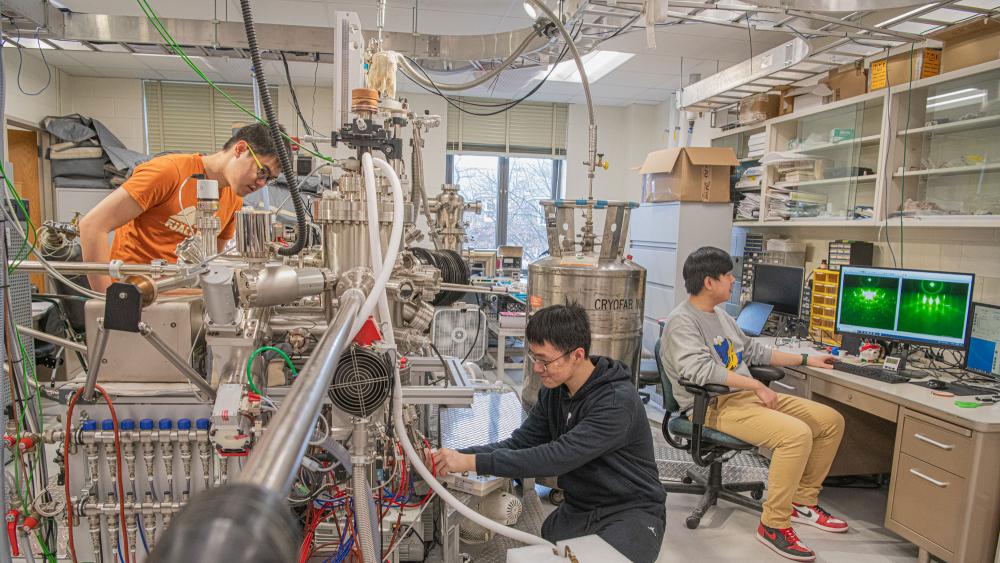
Knappenberger’s research group is particularly interested in understanding how molecular vibrations — the natural oscillation of atoms within a molecule — disrupt spin states. For example, Nate Smith, a graduate researcher in the Knappenberger group, is investigating how precise atomic- and molecular-level control can influence electron spin behavior in metal nanostructures. By combining the creation of advanced nanomaterials with a state-of-the-art technique that uses lasers to image materials under magnetic fields, they can study how the spin of a material’s electrons “couples” or interacts with the vibrations.
“One practical thing that you can do is actually suppress those vibrations,” Knappenberger explained. “We’ve been using solvents and ligands that make the system more rigid so that the electron retains its memory. This is analogous to shielding the synchronized dancers from the wind that disrupts their precision; molecular vibrations are like the wind in this analogy. Achieving a fundamental understanding of why electron spin and vibration couple could lead to breakthroughs, allowing us to design materials where we control vibrations to give the desired effects.”
This research could have important ramifications for everyday use, Knappenberger said. For example, extending the lifetime of specific spin states and enabling controlled transitions between them could potentially lead to energy-efficient spintronic devices used in digital storage and boost the robustness of quantum computers.
While physics today is most associated with quantum information science, Knappenberger emphasized the critical role of chemistry in addressing quantum challenges.
“Physicists conceptualize quantum systems, but chemists can play an important role by providing the material solutions needed to embed those ideas into reality,” he said. “Chemists can contribute by synthesizing and designing materials that function outside of a vacuum. … The challenges of practical quantum information sciences present problems we realize we don’t fundamentally understand at the molecular level. That then becomes a research problem for us.”
Penn State is an ideal place to study and answer these questions, according to Knappenberger.
“We are very fortunate to be surrounded by some of the world’s leading experts in the synthesis and characterization of atomically precise materials, theoretical descriptions of electronic and vibrational dynamics, and the measurement of a material’s electronic spin properties,” Knappenberger said. “This powerful make-model-measure approach sets Penn State apart from many other universities in the quantum information sciences arena.”
link